Tangible and Embodied Interaction (2019) – Week 2
Two years ago I went to an art exposition where I saw a presentation of a project called “Smell of Data” by Leanne Wijnsma and Froukje Tan ( https://smellofdata.com/ ). They designed a device that started to produce smell when people were visiting unprotected websites or unsecured WiFi networks. I was very impressed with this project, but barely ever thought about the use of smell in interaction. This week however, I was going to explore smell interactions.
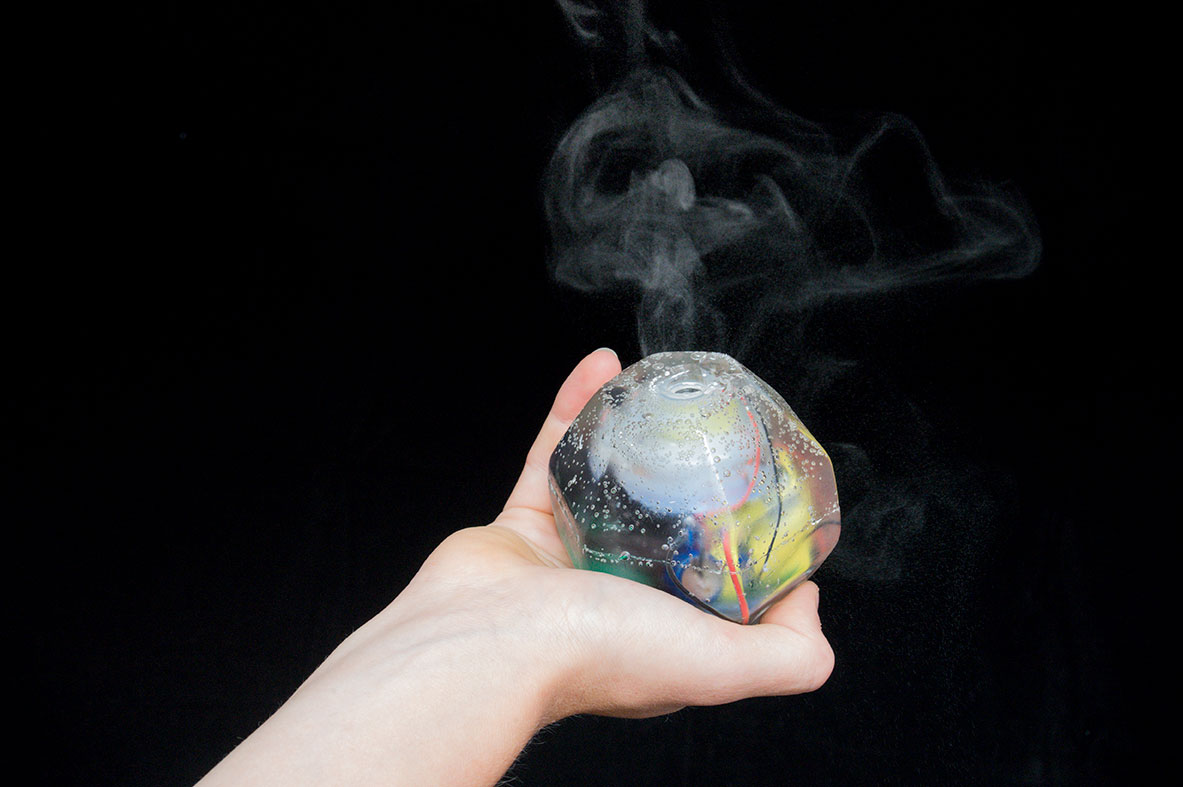
Introduction lecture & literature (18th & 19th of November)
Simon started the introduction lecture with the Google Nose Beta ( https://www.youtube.com/watch?v=VFbYadm_mrw ). It was a really good way to get my interest in the topic. I did not understand that it was an April fool’s joke at first, because apart from the obviously fake examples in the video, it seemed to me like something that could really happen in the future. I think it’s great to unpack this fairly new area and discover it’s possibilities, even though people have a negative attitude towards it, because it offers new ways to create interactions.
The only real problem I see is that disgusting scents can cause a very negative user experience, but on the other hand, we can use disgusting scents to design for example, warnings (e.g. scent added to gas to indicate that there’s a leak).
I’ve been thinking about ways to make my Virtual Reality project from the previous semester more immersive and using scents to increase immersion would have been a great way to do it, although there might be more to smelling than just creating deeper immersion. For example, from the lecture I understood that smell can be used as a tool to stimulate emotions, train one’s memory and reduce stress.
One of the problems with smelling is that it bypasses linguistics, thus that explains why I often fail to find the right words that are linked to something I smell (i.e. on the tip of my nose phenomenon). Smell in general brings a lot of challenges for designers. As Simon Niedenthal presented, smell is slow and difficult to contain, because it is depended on the flow of the air. Therefore, it is important to consider the space that we are using when designing a smell interaction. In addition, it is hard to obtain smell materials because they are very limited to the physical materials and in contrast to the RGB-system for color, there is no system for classifying odors as we could probably make an “unlimited” amount of different smells in comparison. The one thing troubling me most is that we’re bound to replacing cartridges of different smells just like we do with printers.
I understood one way to design smell interactions for our digital systems would be through the use of an olfactory display, which is a combination of hardware, software and chemicals that outputs scents. Ways to deliver scents would be through fans, tubes or encapsulation.
I was unfamiliar with the term olfactory and decided to research its meaning. The olfactory system, or sense of smell, is the sensory system used for smelling (olfaction).
Because the articles were written and provided by our teacher, Simon Niedenthal, it did not feel relevant to me to check the publications even thought it was one of the seminar insights from last week. Both the articles felt like an expansion of the lecture, providing and building on game concepts that involve smell interaction.
The article ” Beyond Smell-O-Vision: Possibilities for Smell-Based Digital Media ” argues if and how smell can be incorporated in games, specifically when it comes to unlocking memory and enhancing mental functions. Olofsson et al. (2017) believe that maintaining the sense of smell is important for health, nutrition, and well-being.
Like I mentioned earlier, there might be more to smelling than just creating deeper immersion. The authors suggest that smell can be incorporated into games not just as a layer of immersion, but rather as a part of the core challenges in a game. They state that an important feature of a game is that the difficulty level of the game adjusts when the skill level of the player improves. From my own gaming experience, I can tell that this is one of the most rewarding feelings while playing a game and the one that keeps me playing a game. Being equally matched with people or AI’s from the same skill level gives the opportunity to outplay and progress (i.e. learn). I discussed this phenomenon with some of my peers and we argue that it might not be smart to incorporate smell as one of the core challenges, seeing as it is very hard to adjust smell in level of difficulty.
However, I personally do see it as a tool to provide guidance in for example, horror or adventure games. For instance, for the game Outlast (Red Barrels, 2013), I think it would have been a great addition to have scent, not just as another immersive layer to make the game even scarier, but as a tool to indicate potential danger or escape routes. I could imagine someone memorizing the scent of danger when exposed to it multiple times, just like the scent of gas to indicate a potential leak. Possible ways I could think of to improve the level of difficulty through the game would be to takeaway other indicative senses like sound over time, but that comes with the risk of getting used and thus unaware to scents as mentioned in the other article “Skin Games: Fragrant Play, Scented Media and the Stench of Digital Games” (Niedenthal, 2012). The question is, what would this add to the game? Would it provide a better gaming experience? Would it make the game scarier? Or, would it just be an additional layer creating unnecessary immersion?
My suggestive example as mentioned above is a little more in line with the other given examples in the article that are mainly based on memorizing odors, but it seems to me that incorporating smell in games becomes very limited to a specific genre of games that actually focus on having smell as the main objective.
The article “Skin Games: Fragrant Play, Scented Media and the Stench of Digital Games”, is much more of an inspiration source of possible ways to actually implement smell interaction into games, although having a game like Scratch me, Sniff me seems very unnecessary and humiliating to me. It was very fun to read, due to all the unique gaming interactions that had been created through the use of smell.
There was one live action role playing game concept that specifically stood out to me called ‘Dragonbane’, where scents were used to enhance the world, plot and character, but this is just another way of adding immersion, making the game more impactful.
I interpreted from the article that there were two important factors to keep in mind when designing a smell interaction for games:
- We can adapt / get used to odors that we have been exposed to over time.
- Due to individual smell capabilities and preferences, we have to think about customization and a variety of scents.
To conclude my reflection on the articles, having a website like Basenotes (http://www.basenotes.net/ ) does imply to me that there is an audience for scents and even though I think games are a great way to implement smell interaction, I would like to explore a broader aspect of its implementation in the upcoming days.
List of keynotes from the lecture and the article:
- There is more to smell than creating deeper immersions, it can be used as a tool to stimulate emotions, train one’s memory and reduce stress.
- Implementing smell interaction in gaming offers new possibilities, although I argue that it may be limited to a specific genre of games.
- It is important to consider the design space that we are using when designing a smell interaction.
- We are limited to physical materials and there is no system for classifying odors (like RGB for color / light).
- We can adapt / get used to odors that we have been exposed to over time.
- There are individual smell capabilities and preferences.
Workshop (20th of november)
Even though I wanted to explore a broader aspect of smell interaction, the workshop and assignment for the presentation on Friday were still related to game design. The introduction of the workshop really felt like a summary of the skin games paper that we had to read. It did however, clarify a lot of confusions I had with the games Simon talked about in his paper.
For example, I did not really understood what the scratch-n-sniff game was really about, but I now understand that it can be used as an additional layer for multiple (digital) games. While reading the paper, I was also really confused by the Kinect smell concept. Discussing the social influences that come with playing Kinect related games due to, for instance, sweaty players made me understand its relation to the topic.
Just like I thought after reading the article, smell related games are bound to a specific genre of games. According to Simon, smell games are pedagogical games. Before we were going to manipulate an existing game by adding a layer of smell, we tried a few experiments in the workshop.
Scented bombs of rosewater
Simon prepared an empty eggshell for each group that we could fill up with rosewater. We were free to do with the egg what we wanted to do, so our group decided to throw the egg at one another. Instead of having the feeling that I would get dirty and smelly when the egg was thrown at me, I felt rather comfortable, knowing that I would be smelling nicely like rosewater. However, I really felt a tension when throwing to egg to someone else. Not as in “I hope it breaks in his or her face”, but more as is “please don’t break it”. Thinking about the nice smell of the egg changed my approach to the game.


Kodo – an ancient smell game
Kodo was about smelling three different scents in round one and then guessing the correct order of the scents in round two. I did not really like this game, as it is pretty straight forward. I also had an easy time distinguishing the three presented smells from one another, because I couldn’t link one of them to anything, I could like one of them to cookies and I linked the other one to a fruity kind of smell. This made it easy to distinguish the smells when they were hustled at the end of the game.
Vortex cannons
Now for the last experiment we used vortex cannons to deliver smells over a short distance. To my surprise, the distance was quite large, it had a pretty fast pace considering smells are slow, and the canons were actually quite accurate. We came up to play a game of dodge ball smell, which I think is fun to do once, but gets boring after a while.

I was not really convinced by the games as I hoped I would be. Smell seemed like a really interesting topic at the beginning of this week and even though I was having a lot of fun exploring the topic, I don’t see that much value in smell related gaming.
Ideation & Prototyping (20th of November)
The assignment for this week was about manipulating an existing game through the use of smell interaction. This means that we were to change the rules, game controls and scoring for an existing game. After a really quick and dirty brainstorm session, we came up with the idea to manipulate the game of dominoes. By swapping the 6 different numbers with scents, we were easily able to change the game. Since we had very little time till Friday, we rapidly wrote down our concept in relation to the original rules to get started with our prototyping phase.
Click here for more information about dominoes.
The original concept of dominoes consists of 28 different blocks. The game can be played with 2 to 4 persons and depending on the amount of participants each players receives a certain amount of blocks. To see if an answer was correct, we had to implement a hidden icon to hand out scores, because we were not able to see if an answer was correct.

As the game became more clear to us, the concept and rules above became less relevant. At first, we also wanted each player to put his or her name, color or whatever on the blocks they played, but since this was not implemented in the original game, we decided to drop the idea. We also thought about putting a hidden abbreviation on each block to check the correct answers through the use of post-its or tape. We eventually used a UV pen to write down the hidden icons, because this could prevent possible cheating. Before we started prototyping, we searched for 6 easily distinguishable scents to be swapped with the numbers from the original game.

Because the essential oils containing the scents were kind of strong, we decided to increase the size of each block. This would prevent a mix-up in scents (i.e. smellscape). We went down to the workshop to make the blocks from cardboard and added a round pad on each side to put the different scents on.

List of seminar notes (21th of November)
Compared to the seminar from last week, this seminar was kind of informal and less prepared. Nonetheless, I picked up some important notes.
- Simon mentioned that during one of his experiments that he wrote about in the paper, the group that only worked on smell memory also improved on visual memory.
- In the opera example in one of his papers, a design challenge that came up was: how do we get the scent to all the people in the same room at the same time, but then also getting rid of the scent in order to introduce a new one? Their solution was rather simple: after each particular scent they would blow fresh air out of the tubes that they used to deliver smell.
- When designing smell interaction games, set up a small tutorial to introduce the associations of smell in relation to the game, characters and themes so that the user has an understanding of the game, story and so on.
- Encapsulation is about experiencing the scent after an action has been performed. For example, scratching (scratch-n-sniff), breaking an egg or breaking a bubble or balloon.
After the seminar, there was one thought that popped into my mind. Simon stated that, if one were to lose his sense of smell he or she could become depressed. I wonder if scent could, just like music, also enhance the happiness of people (with dementia). This thought got into my mind after I remember the following video:
User testing & finalizing our prototype (21th of November)
We decided to prepare our prototype for user-testing, by putting the drops of essential oils on the round pads and writing down the abbreviation of the used oil with the UV-pen. We did a lot of very important discoveries, even before we ran the user-tests.

After putting each drop of oil on the pad, we discovered that the oil leaves a mark on the cardboard pad making it easily distinguishable from the neutral scent. Thus, we had to put some kind of odorless liquid on the neutral pad.
After a few minutes, each oil drop had a different form and color contrast (i.e. pattern), thus the dominoes could potentially be identified and memorized. I think one way to solve this problem would be, for instance, using cotton pads to soak up the essential oils without leaving visual stains.
Another problem that we encountered was that I was the only person to properly smell the scent of Coconut. All the other members in our group had a hard time smelling the coconut in the substance, making it difficult to distinguish it from all the other strong scents.

Because we had little time, we decided to run a user-test with 4 of 7 different scents (if we include neutral as a scent). To make sure there was a stain on the neutral pad, we used some water. We found two people in the workshop that were willing to play the game. We gave each of the players four random blocks and we placed one block on a table. As an introduction to the scents, we gave them some time to smell all the pads. After that, we had them play the game.

To my surprise, they placed every single block in the right position and even caught us on a huge mistake. We accidentally put in a wrong scent (kind of a great mistake for the testing phase if you ask me) and the users were able to point out that there was a scent not belonging to the game. In addition, they pointed out at the start of the game that we should have something like coffee to neutralize the smells.
One of the things I observed myself was that they would not bend over the table to smell the block on the table, but they rather always picked up the block to smell the scent and compare it to the scent of the block in their hand.

The participants mentioned that is was a frustrating, but fun game to play. “It was challenging in a good way”, one of them mentioned. Due to all the different and strong scents the game became confusing after a while, thus playing it for too long would probably become an issue.
Most important notes from the testing phase
- Oil leaves a mark on the cardboard pad making it easily and visually distinguishable from other scents, thus we have to use different materials to put the scents on.
- For some people a scent is easier to recognize than for others, so it is important to choose the right scents that can be distinguished.
- The game is very playable, since the participants had each answer correct and even managed to point our mistake of putting a wrong scent in the game.
- Use coffee beans to neutralize the scents to prevent players from getting confused.
Presentation – Final Thoughts (22th of November)
There were lots of nice projects, but the one I personally liked most was smell quartet from Roel, Manuel, Andrei & Kim. They really took an old fashion, easy to play, Dutch game and changed it into a fun game that is easy to play with smell. Unfortunately it was one of the only games that was not played as a demo, so it’s difficult to determine whether the game is properly playable or not. I could imagine that it would be difficult to smell different scents within the same category and make the right guesses.
One thing that I noticed during the presentations is that, in hindsight, everyone discovered in that materials such as cardboard and MDF have no neutral scent. This made it extra difficult to work with scents, because the scents got mixed up with the scent of the material. Fortunately our thin and unprocessed pieces of cardboard caused little issues in comparison to people that used the laser cutter for creating prototypes. According to Julija, one way to get rid of the strong scent of the material was to use soda and vinegar.
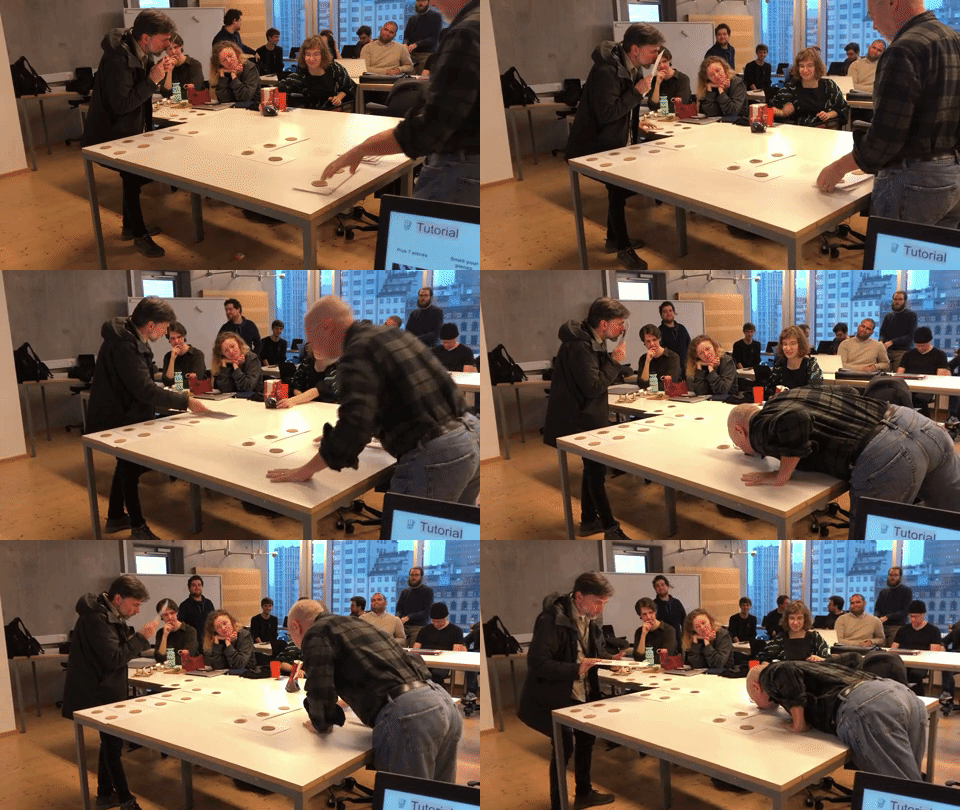
In regard to our presentation, one tip Simon mentioned was to look into the cultural aspect of the game. This could give you some more insights on how the game is played in different cultures, which can be used to manipulate the game in a specific way. According to Henrik, the block have become a little too big. Even thought the scents are strong, the blocks were unnecessarily large. The participants during the presentation (i.e. Simon & Henrik) thought it was mandatory to lean over the table and that it was not allowed to pick up the blocks, so this had to be made more clear. A last mention from Simon was that the intensity of the different scents varies a lot and that the intensity of some the scents can change over the duration of time. This makes the game a little more variable in a way, but I think it can become problematic over time due to the fact that different intensities can be distinguished more easily.
In conclusion, I had a lot of fun discovering game interactions with smell! I see less potential in designing for it in contrast with Glanceability, but so far it has been fun exploring different fields of interaction.
List of final notes from the presentations
- Materials such as cardboard and MDF have no neutral scent, one way to get rid of the strong scent of the material was to use soda and vinegar.
- Look into the cultural aspect of the game. This could give you some more insights on how the game is played in different cultures, which can be used to manipulate the game in a specific way.
- Even thought the scents are strong, the blocks were unnecessarily large. By using different material such as cotton pads or a sponge, the scents are more easily encapsulated, thus easier to distinguish.
Literature
Niedenthal, S. (2012). Skin Games: Fragrant Play, Scented Media and the Stench of Digital Games. Eludamos. Journal for Computer Game Culture. 2012; 6 (1), pp. 1-3
Olofsson, J. K., Niedenthal, S., Ehrndal, M., Zakrzewska, M., Wartel, A., & Larsson, M. (2017). Beyond Smell-O-Vision: Possibilities for Smell-Based Digital Media. Simulation & Gaming, 48(4), 455–479. https://doi.org/10.1177/1046878117702184
 Jesper van Laar's Reflective Journal